Guides
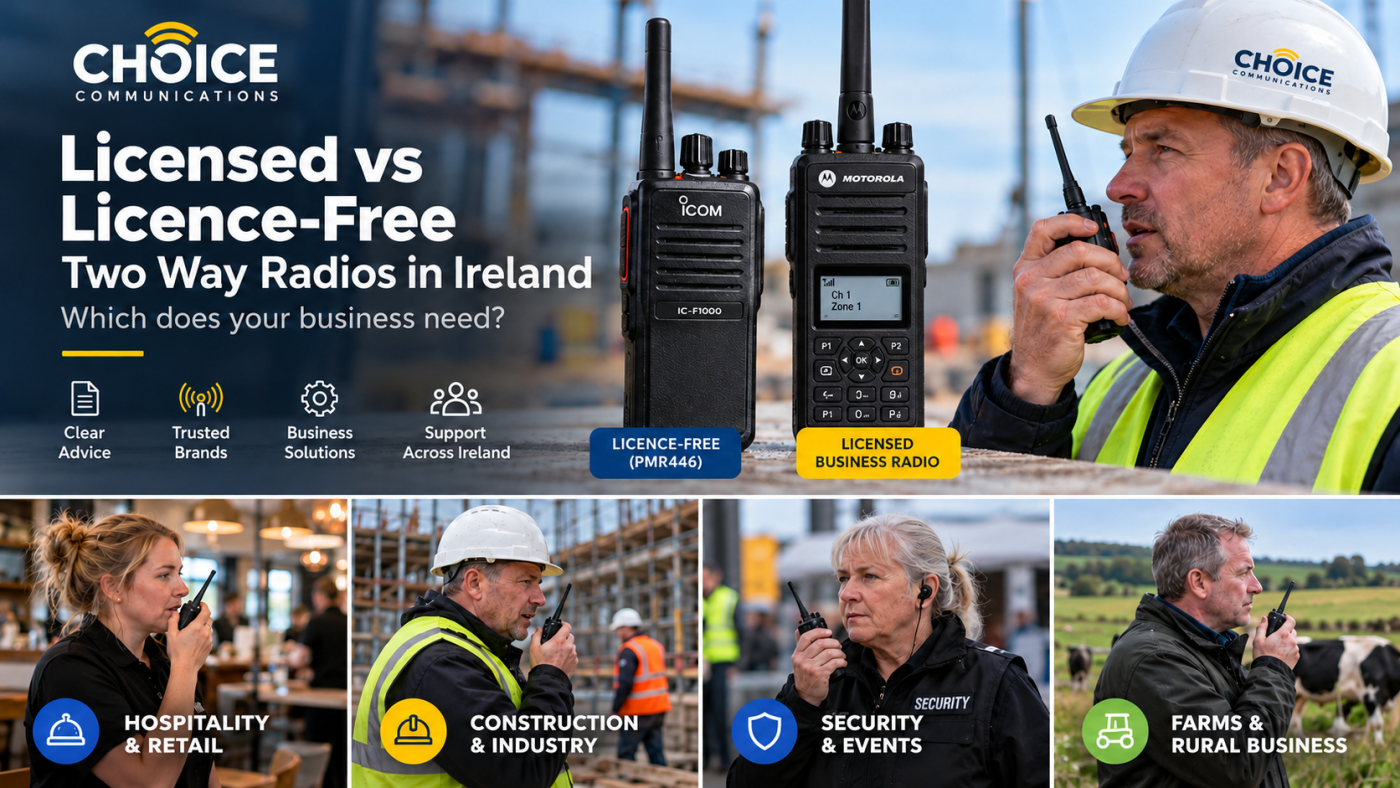
Licensed vs Licence-Free Two Way Radios in Ireland: Which Does Your Business Need?
Oct
If your business needs two way radios, one of the first decisions is whether to choose licence-free radios or a licensed business radio system. Both can be excellent choices. The right answer depends on where the radios will be used, how far they need to work, how important clear channels are, and how critical communication is to your operation.
For a small shop, hotel, warehouse or event team working over a relatively compact area, professional licence-free radios can be simple, practical and cost-effective. For a busy construction site, industrial facility, security operation or larger organisation where dependable communication is essential, a licensed system may be the better option.
Choice Communications supplies professional two way radios throughout Ireland and has been helping businesses choose suitable radio systems for more than two decades. This guide explains the differences in plain English so you can make a more informed decision.
If you want radios that can be purchased and used immediately with no individual radio licence, a professional PMR446 licence-free system may be ideal. If you need an assigned business-radio channel, greater flexibility, higher-power equipment, repeaters or a system designed for more demanding operational use, speak to a radio specialist about licensed equipment.
Table of Contents
Licensed vs Licence-Free Two Way Radios: The Main Differences
| Feature | Licence-Free Radios | Licensed Business Radios |
|---|---|---|
| Licence required? | No, when compliant PMR446 equipment is used within the permitted conditions | Usually yes for traditional business-radio operation |
| Setup | Simple and quick | Requires suitable equipment, programming and licensing arrangements |
| Channel protection | Shared spectrum; no protection from interference | Can provide assigned business-radio frequencies appropriate to the licence |
| Power / system flexibility | Restricted by PMR446 rules | Wider choice of professional equipment and system design options |
| Repeaters / larger systems | Not the normal PMR446 model | Available where the system and licence allow |
| Typical users | Retail, hospitality, schools, smaller warehouses, leisure and smaller events | Construction, security, manufacturing, heavy industry, larger sites and business-critical operations |
What Are Licence-Free Two Way Radios?
Licence-free radios used by businesses in Ireland are commonly based on PMR446. These are handheld radios designed to operate within designated licence-exempt frequencies and technical limits. Because compliant equipment is exempt from individual licensing, a business can purchase suitable radios and begin using them without applying for a standard Business Radio Licence.
This makes licence-free radios attractive when simplicity matters. There is no individual radio licence to arrange, and a small team can often be equipped quickly without the additional administration associated with a licensed system.
Choice carries a range of licence-free walkie talkies and professional PMR446 radios from manufacturers including Motorola, Icom, Hytera, Entel and Mitex.
PMR446 in Ireland: useful facts
- PMR446 operates within designated 446 MHz spectrum.
- ComReg classifies compliant PMR446 equipment as licence-exempt when used within the applicable conditions.
- Licence-exempt short-range equipment operates on a non-interference and non-protected basis.
- That means users cannot expect a dedicated channel or protection from other legitimate users of the same spectrum.
For the technical rules, see ComReg’s current guidance on permitted short-range devices in Ireland.
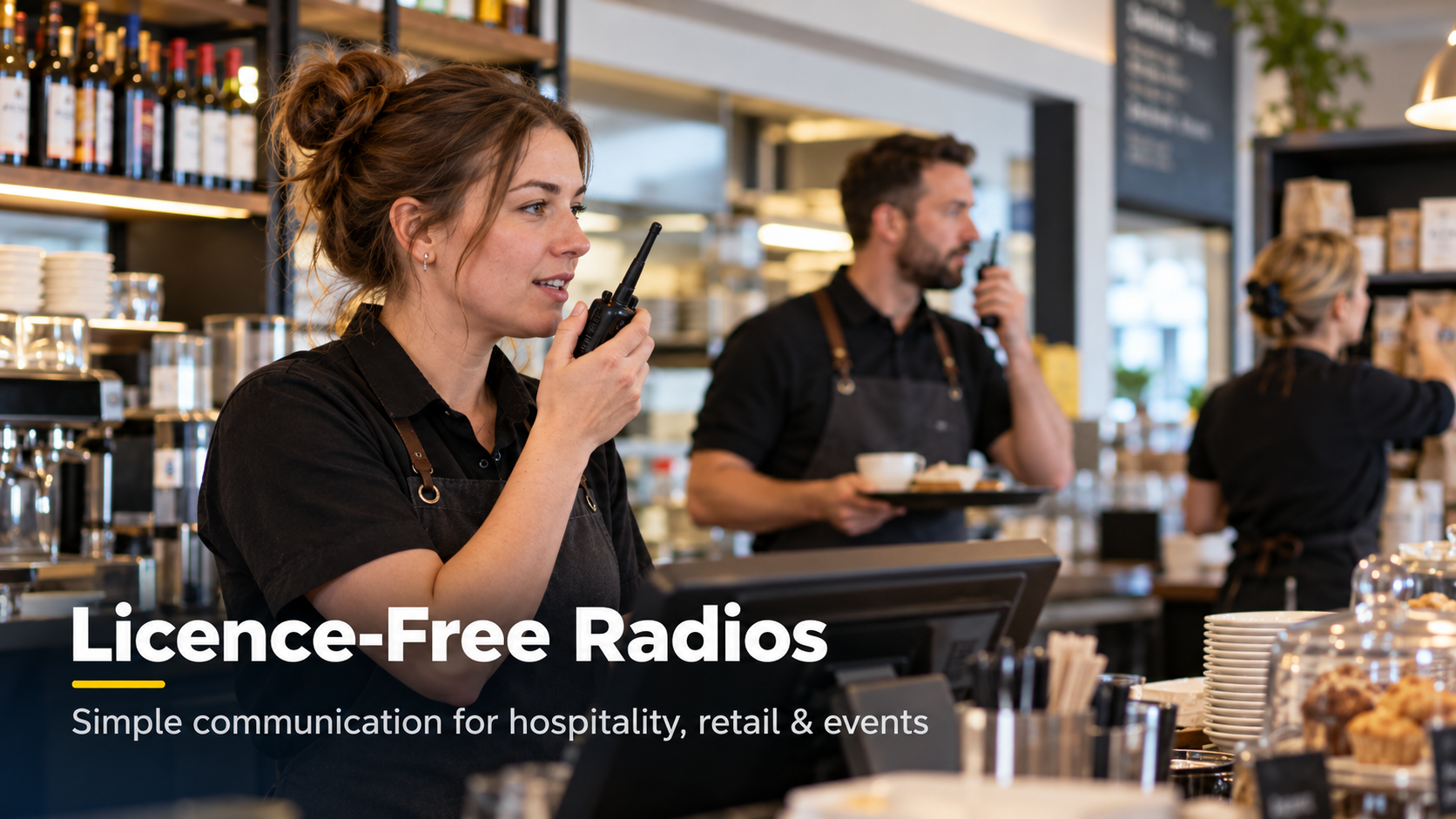
When do licence-free radios work well?
They are often a very good fit where teams work within a reasonably compact building or site and where occasional use of shared radio spectrum is acceptable. Examples can include:
- Hotels, restaurants and hospitality teams
- Retail shops and shopping environments
- Schools, clubs and leisure facilities
- Smaller warehouses and stockrooms
- Temporary event teams
- Small businesses that simply need straightforward push-to-talk communication
A good professional licence-free radio should not be confused with a cheap toy walkie talkie. There are rugged commercial PMR446 models with strong audio, long battery life, suitable accessories and digital options. For many businesses, they provide exactly the level of communication required.
What are the limitations?
The main limitation is that licence-free spectrum is shared. Another nearby business, event or user may legally be operating on the same frequencies. Tone systems such as CTCSS or DCS can help groups avoid hearing unwanted traffic, but they do not turn a shared frequency into a private or protected channel.
Range is also highly dependent on the real environment. Buildings, reinforced concrete, steel structures, terrain, radio position and interference can all affect coverage. Claims such as “up to several kilometres” should therefore be treated as ideal-condition figures rather than guarantees for a working site.
A radio that performs well across open countryside may behave very differently inside a concrete hotel, factory, warehouse or multi-storey building. The working environment matters as much as the number printed on the box.
What Are Licensed Business Radios?
For more demanding commercial use, businesses can operate professional radios under the appropriate ComReg Business Radio licensing arrangements. ComReg describes Business Radio as covering several licence types used by industrial, commercial, security, utility and other organisations that need reliable communication between mobile personnel.
A licensed setup gives a radio specialist much more flexibility when designing a system. Depending on the application and licence, the solution may involve professional handheld or mobile radios, suitable frequencies, repeaters, base stations and other equipment designed around the customer’s site and operating requirements.
You can browse Choice’s licensed two way radio range, or read our separate guide explaining how to get a two way radio licence in Ireland.
ComReg currently states that PMR Business Radio licence fees are based on the quantity of equipment licensed, with a fee per item plus a fixed charge. Fees and procedures can change, so businesses should always check the current ComReg information before applying.
View ComReg’s current Business Radio information and application guidance.
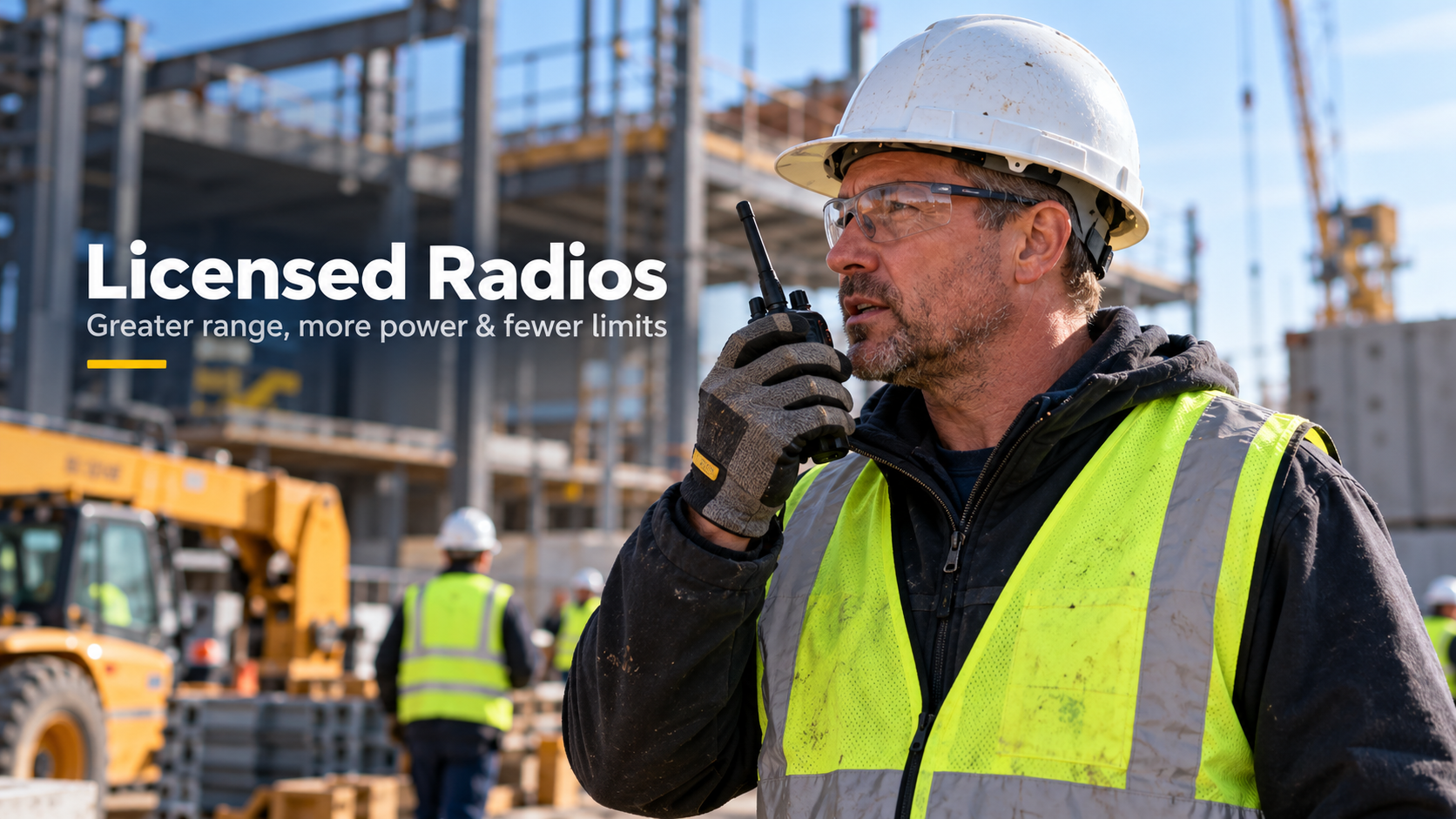
When is a licensed system worth considering?
Licensed systems become particularly valuable when communication is operationally important rather than simply convenient. Typical examples include:
- Construction sites where crane operators, banksmen, supervisors and site teams need dependable communication
- Security operations where staff may need discreet accessories, lone-worker features or more controlled communications
- Factories and manufacturing plants where steel structures, machinery and larger premises affect coverage
- Industrial environments where specialist rugged or ATEX-approved equipment may be required
- Farms and agricultural businesses operating over larger outdoor areas
- Larger events, venues and multi-building sites
Licensed radios may also offer access to higher-powered professional equipment than licence-free PMR446 alternatives, although the correct system depends on the specific frequencies, equipment and licence in use.
Does Licensed Mean Better?
Not automatically.
A licensed system is not necessarily the best choice for every business. If six members of staff need to communicate within a small hotel, shop or warehouse, a quality licence-free system could be simpler and entirely adequate. Paying for a more complex solution would not automatically make it better for that particular customer.
Likewise, choosing licence-free radios simply to avoid licensing can be a false economy if the radios are being used across a challenging industrial site where reliable communication is critical.
The right question is: “Which system is appropriate for the environment, coverage and operational importance of our communications?”
What About Privacy and Security?
This is an area where the terminology can be confusing.
Licence-free PMR446 channels are shared. Other users may be operating on the same frequencies, and licence-exempt users are not entitled to protection from interference. That makes licence-free systems less suitable where an organisation needs tightly controlled radio communications.
However, a radio licence itself is not an encryption system. A professional licensed digital radio network can support additional features such as encryption, group calling and other security functions where suitable equipment is selected and correctly configured. If sensitive communication matters, tell your supplier at the start rather than assuming every licensed radio provides the same level of privacy.
Analogue or Digital: A Separate Decision
Licence type and radio technology are related, but they are not the same decision. You can find analogue and digital professional systems, and there are also digital licence-free radios.
Digital radios can provide benefits such as clearer audio at the edge of coverage, better use of channels and additional functions on compatible professional systems. Analogue remains useful in many straightforward applications and can sometimes be the simplest option where an existing fleet is already in service.
So when comparing radios, think about two separate questions:
- Do we need a licence-free or licensed system?
- Should our chosen system be analogue or digital?
Which System Is Right for Your Business?
Start by considering professional licence-free radios. Simple operation and compact coverage may make PMR446 ideal.
A licensed professional system is often worth serious consideration because coverage and dependable communication are critical.
Consider licensed digital radios where controlled communications, accessories and advanced features matter.
Either can work. Building size, shelving, steelwork and nearby radio users should influence the decision.
Coverage becomes especially important. Professional licensed radios may provide more suitable system options.
Before buying, consider whether two way radio hire would be more economical.
Ask these seven questions before buying
- How large is the area the radios need to cover?
- Will they be used mainly indoors, outdoors or both?
- Are there concrete walls, steel structures, machinery or multiple buildings?
- How many users need radios?
- Would occasional interference be merely inconvenient, or could it create a real operational or safety issue?
- Do you need specialist functions such as lone worker, emergency buttons, ATEX approval, GPS, encryption or repeaters?
- Is this a permanent requirement, or would hiring radios make more sense?
Businesses sometimes choose radios solely on price or the maximum range quoted by the manufacturer. In practice, choosing equipment around the actual site, building materials, number of users and importance of communication usually produces a much better result.
Can Choice Communications Help With Licensing?
Yes. Choice Communications is based in County Cork and supplies professional radio equipment to organisations throughout Ireland. If a licensed business radio system is the right option, we can help you understand the equipment requirements and the information needed for the licensing process.
For the detailed application process, read our step-by-step guide to getting a two way radio licence in Ireland. For official regulatory information, always refer to ComReg’s Business Radio guidance.
Frequently Asked Questions
Do all two way radios need a licence in Ireland?
No. Compliant PMR446 handheld radios can be operated on a licence-exempt basis within the applicable Irish rules. Other professional business-radio systems may require the appropriate ComReg licence.
Can a business use licence-free radios?
Yes. Licence-free does not mean “for consumers only”. Professional PMR446 radios are widely used by businesses where their range, channel-sharing model and features are suitable for the job.
Are licensed radios more powerful?
Professional licensed systems can provide access to equipment and system designs that are not available under the restricted PMR446 licence-free model. The correct permitted power and configuration depend on the radio, frequency and licence involved.
Are licence-free walkie talkies private?
No. PMR446 uses shared spectrum. Tone codes can stop your radio from playing unwanted transmissions through the speaker, but they do not make the frequency private. If privacy is important, discuss suitable licensed digital equipment and security features with your supplier.
How far will licence-free radios work?
There is no single reliable distance figure for every location. Real-world range can change significantly depending on terrain, walls, steelwork, elevation and interference. The best approach is to choose equipment based on the environment in which it will actually be used.
Should I buy or hire business radios?
If you need radios regularly, buying usually makes sense. For temporary projects, seasonal requirements or events, radio hire can be a more practical option.
Regulatory information in this guide is intended as a practical overview. Radio spectrum rules and licence fees can change, so businesses should refer to current ComReg guidance for official requirements.